
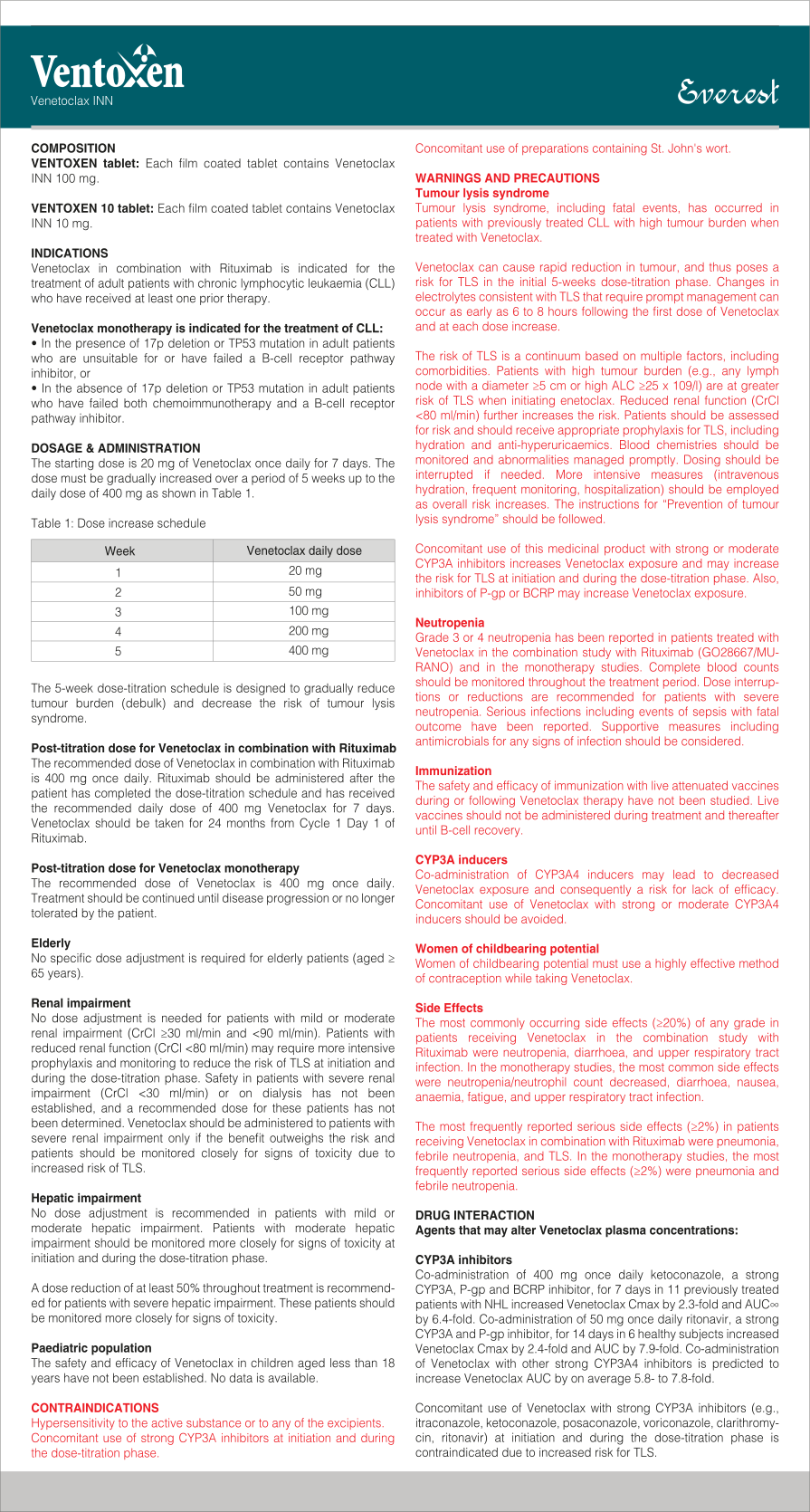
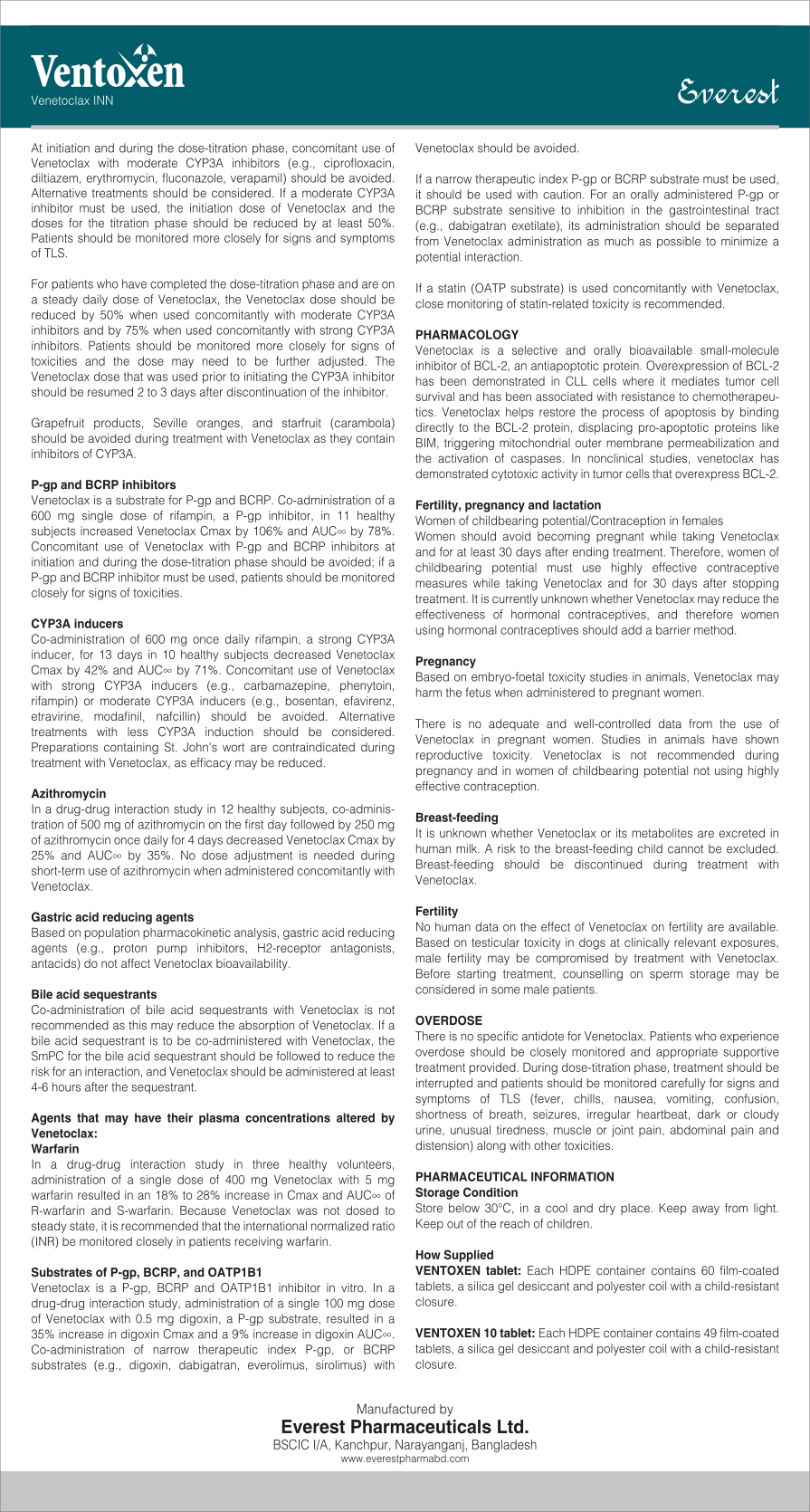
Composition, Indications, Dosage, and Warnings
Ventoxen
Venetoclax INN
Everest
COMPOSITION
Ventoxen tablet: Each film coated tablet contains Venetoclax $\text{INN } 50\text{ mg}$.
Ventoxen 10 tablet: Each film coated tablet contains Venetoclax $\text{INN } 10\text{ mg}$.
INDICATIONS
Venetoclax in combination with Rituximab is indicated for the treatment of adult patients with Chronic Lymphocytic Leukemia ($\text{CLL}$) who have received at least one prior therapy.
Venetoclax monotherapy is indicated for the treatment of $\text{CLL}$:
- In the presence of $17\text{p}$ deletion or $\text{TP53}$ mutation in adult patients who are unsuitable for or have failed a B-cell receptor pathway inhibitor.
- In the absence of $17\text{p}$ deletion or $\text{TP53}$ mutation in adult patients who have failed both chemoimmunotherapy and a B-cell receptor pathway inhibitor.
DOSAGE $\&$ ADMINISTRATION
The starting dose is $20\text{ mg}$ of Venetoclax once daily for 7 days. The dose must be gradually increased over a period of 5 weeks up to the final dose of $400\text{ mg}$ as shown in Table 1:
Week | Venetoclax daily dose |
1 | $20\text{ mg}$ |
2 | $50\text{ mg}$ |
3 | $100\text{ mg}$ |
4 | $200\text{ mg}$ |
5 | $400\text{ mg}$ |
The 5-week dose-titration schedule is designed to gradually reduce tumour burden (debulk) and decrease the risk of tumour lysis syndrome.
Post-titration dose for Venetoclax in combination with Rituximab
The recommended dose of Venetoclax in combination with Rituximab is $400\text{ mg}$ once daily. The dosing of $\text{CLL}$ treatment in the fixed duration treatment setting is up to 24 months from Cycle 1 Day 1 of Rituximab.
Post-titration dose for Venetoclax monotherapy
The recommended dose of Venetoclax is $400\text{ mg}$ once daily. Treatment should be continued until disease progression or no longer tolerated by the patient.
Elderly
No specific dose adjustment is required for elderly patients (aged $> 65$ years).
Renal impairment
No dose adjustment is needed for patients with mild or moderate renal impairment ($\text{CrCl} \ge 30\text{ mL/min}$). For patients with severe renal impairment ($\text{CrCl} < 30\text{ mL/min}$) or end stage renal disease, the use of Venetoclax should be based on a benefit/risk assessment, and a recommended dose for these patients has not been established. Patients with severe renal impairment should be monitored more closely for signs of toxicity due to increased risk of $\text{TLS}$.
Hepatic impairment
No dose adjustment is needed in patients with mild or moderate hepatic impairment. Patients with severe hepatic impairment should be monitored more closely for signs of toxicity at initiation and during the dose-titration phase.16
A dose reduction of at least 17$50\%$ throughout treatment is recommended for patients18 with severe hepatic impairment. These patients should be monitored more closely for signs of toxicity.
Paediatric population
The safety and efficacy of Venetoclax in children aged less than 18 years have not been established. No data is available.
CONTRAINDICATIONS
Hypersensitivity to the active substance or to any of the excipients.
Venetoclax is contraindicated with strong $\text{CYP3A}$ inhibitors at initiation and during the dose-titration phase.
Concomitant use of preparations containing St. John’s wort.
WARNINGS AND PRECAUTIONS
Tumour lysis syndrome
Tumour Lysis Syndrome ($\text{TLS}$), including fatal events, has occurred in patients treated with Venetoclax. The risk of $\text{TLS}$ is a continuum based on multiple factors, including tumor burden and co-morbidities. Patients should be assessed for risk of $\text{TLS}$ and receive appropriate prophylaxis.
Neutropenia
Grade 3 or 4 neutropenia has been reported in patients treated with Venetoclax in combination with Rituximab and as monotherapy. Complete blood counts should be monitored frequently. Dose adjustments may be necessary. For management of neutropenia, the physician should follow standard guidelines (e.g., dose interruptions, dose reductions, and treatment with G-CSF).
Immunization
The safety and efficacy of immunization with live attenuated vaccines during or following Venetoclax therapy have not been studied. Live vaccines should not be administered during treatment and thereafter until B-ce19ll recovery.
CYP3A inducers
Concomitant use of $\text{CYP3A}$ inducers may lead to decreased Venetoclax exposure and consequently a risk for lack of efficacy. Concomitant use of Venetoclax with strong or moderate $\text{CYP3A}$ inducers should be avoided.
Women of childbearing potential
Women of childbearing potential must use a highly effective method of contraception while taking Venetoclax.
Side effects
The most commonly occurring side effects ($> 20\%$) of any grade in patients receiving Venetoclax in combination with Rituximab were neutropenia, diarrhoea, and upper respiratory tract infection.
The most frequently reported serious side effects ($> 2\%$) in patients receiving Venetoclax in combination with Rituximab were pneumonia, febrile neutropenia, and $\text{TLS}$.
The most frequently reported side effects ($> 20\%$) of any grade in patients receiving Venetoclax monotherapy were neutropenia, diarrhoea, nausea, and upper respiratory tract infection.
The most frequently reported serious side effects ($> 2\%$) were pneumonia and febrile neutropenia.
DRUG INTERACTION
Agents that may alter Venetoclax plasma concentrations:
CYP3A inhibitors
Co-administration of $400\text{ mg}$ once daily ketoconazole, a strong $\text{CYP3A}$ inhibitor, with $50\text{ mg}$ single dose Venetoclax in 11 healthy subjects increased Venetoclax $\text{Cmax}$ by $2.3$-fold and $\text{AUC}_{\infty}$ by $6.0$-fold. Co-administration of $50\text{ mg}$ single dose Venetoclax with $400\text{ mg}$ ritonavir, a $\text{CYP3A}$ and $\text{P-gp}$ inhibitor, for 14 days in 6 healthy subjects increased Venetoclax $\text{Cmax}$ by $2.4$-fold and $\text{AUC}_{\infty}$ by $7.9$-fold. Concomitant use of Venetoclax with other strong $\text{CYP3A}$ inhibitors is predicted to increase Venetoclax $\text{AUC}$ by $5.0$- to $8.0$-fold.
Concomitant use of Venetoclax with strong $\text{CYP3A}$ inhibitors (e.g., itraconazole, ketoconazole, posaconazole, voriconazole, clarithromycin, telithromycin) is contraindicated during the dose-titration phase.
At initiation and during the dose-titration phase, concomitant use of Venetoclax with moderate CYP3A inhibitors (e.g., ciprofloxacin, diltiazem, erythromycin, fluconazole, verapamil) must be avoided. If a moderate CYP3A inhibitor must be used, the dose of Venetoclax must be reduced by at least 50% and patients should be monitored more closely for signs and symptoms of TLS.12
For patients who have completed the dose-titration phase and are on a steady daily dose of Venetoclax, the Venetoclax dose should be reduced by 50% when used concomitantly with moderate CYP3A inhibit3ors and by 75% when used conco4mitantly with strong CYP3A inhibitors. Patients should be monitored more closely for signs of toxicities and the dos5e may need to be further adjuste6d. The Venetoclax dosage in patients with chronic kidney disease (CKD) should be resumed 2 to 3 days after discontinuation of the inhibitor.
Grapefruit products, Seville oranges, and starfruit (carambola) should be avoided during treatment with Venetoclax as they contain inhibitors of CYP3A.
P-gp and BCRP Inhibitors
Venetoclax is a substrate for P-gp and BCRP. Co-administration of a 600 mg single dose of rifampin, a P-gp inhibitor, in 11 healthy subjects increased Venetoclax Cmax by 106% and AUC $\infty$ by 78%. Concomitant use of Venetoclax with P-gp and BCRP inhibitors at initiation and during the dose-titration phase must be avoided. If a P-gp and BCRP inhibitor must be used, patients should be monitored carefully for signs of toxicities.
CYP3A Inducers
Co-administration of 600 mg once daily rifampin, a strong CYP3A inducer, for 13 days in 11 healthy subjects decreased Venetoclax Cmax by 42% and AUC $\infty$ by 71%. Concomitant use of Venetoclax with strong CYP3A inducers (e.g., carbamazepine, enzalutamide, rifampin) or moderate CYP3A inducers (e.g., bosentan, efavirenz, etravirine, modafinil, nafcillin, ritonavir) is expected. Alternative treatments with less CYP3A induction should be considered. Herbal products containing St. John’s wort are known inducers and treatment with Venetoclax should be avoided.
Azithromycin
In a drug-drug interaction study in 12 healthy subjects, co-administration of 500 mg of azithromycin on the first day followed by 250 mg of azithromycin once daily for 4 days increased Venetoclax Cmax by 25% and AUC $\infty$ by 35%. No dose adjustment is needed during short term use of azithromycin when co-administered concomitantly with Venetoclax.
Gastric acid reducing agents
Based on population PK (pharmacokinetic) analysis, gastric acid reducing agents (e.g., proton pump inhibitors, $\text{H}_2$-receptor antagonists, antacids) do not affect Venetoclax bioavailability.
Bile acid sequestrants
Co-administration of bile acid sequestrants with Venetoclax is not recommended as this may reduce the absorption of Venetoclax. If a bile acid sequestrant is to be co-administered with Venetoclax, the $\text{SmPC}$ for the bile acid sequestrant should be followed to reduce the risk of interaction, and the Venetoclax should be administered at least 4-6 hours after the sequestrant.
Agents that may have their plasma concentrations altered by Venetoclax.
Warfarin
In a drug-drug interaction study in three healthy volunteers, administration of a single dose of 400 mg Venetoclax with 5 mg Warfarin resulted in no change in the plasma concentrations of R-warfarin and S-warfarin. Because Venetoclax was not dosed to steady-state, it is recommended that International Normalized Ratio (INR) be monitored closely in patients receiving warfarin.
Substrates of P-gp, BCRP, and OATP1B1
Venetoclax is a weak P-gp and BCRP inhibitor. In a drug-drug interaction study, administration of a single 100 mg dose of Venetoclax with $40\text{ mg}$ simvastatin, a P-gp, BCRP, and OATP1B1 substrate, increased simvastatin Cmax by 35% and simvastatin $\text{AUC}_{\infty}$ by $26\%$. Due to the higher Venetoclax dose during the dose-titration phase, dose reduction of co-administered narrow therapeutic index P-gp or BCRP substrate must be used. It should be used with caution. For an orally administered P-gp or BCRP substrate where the amount or extent of absorption is affected (e.g., dabigatran etexilate), its administration should be separated from Venetoclax administration to minimize the potential interaction.
If a statin (OATP1B1 substrate) is used concomitantly with Venetoclax, close monitoring of statin-related toxicity is recommended.
PHARMACOLOGY
Venetoclax is an selective and orally bioavailable small-molecule inhibitor of BCL-2, an antiapoptotic protein. Overexpression of BCL-2 has been demonstrated in $\text{CLL}$ and $\text{t(11;14)}$ $\text{MCL}$ cell lines. Cell survival and has been associated with resistance to chemotherapy. Venetoclax binds directly to the BCL-2 protein, displacing pro-apoptotic proteins like BIM, resulting in $\text{MOMP}$ (mitochondrial outer membrane permeabilization) and the activation of caspases. In nonclinical studies, Venetoclax has demonstrated cytotoxic activity in tumor cells that overexpress BCL-2.
Fertility, pregnancy and lactation
Women of childbearing potential/Contraception in females7
Women should avoid becoming pregnant while taking Venetoclax and for at least 30 days after ending treatment. Therefore, women of childbearing potential must use highly eff8ective contraceptive measures while taking Venetoclax and for 30 days after stopping treatment. It is not known whether Venetoclax reduces the therapeutic effectiveness of hormonal contraceptives, and therefore women using hormonal contraceptives should add a barrier method.
Pregnancy
Based on embryo-foetal toxicity studies in animals, Venetoclax may harm the foetus when administered to pregnant women.
There is no adequate and well-controlled data from the use of Venetoclax in pregnant women. Studies in animals have shown reproductive toxicity. Venetoclax is not recommended during pregnancy and in women of childbearing potential not using highly effectiv9e contraception.1011
Breast-feeding1213
It is unknown whether Venetoclax or its metabolites are excreted in human 14milk. A risk to th15e breastfed child cannot be excluded. Breast-feeding should be discontinued during treatment with Venetoclax.
Fertility
No human data on the effect of Venetoclax on fertility are available. Based on testicular toxicity in male mice, male fertility may be compromised by treatment with Venetoclax. Therefore, appropriate measures for counseling on sperm storage may be considered in some male patients.
OVERDOSE
There is no specific antidote for Venetoclax. Patients who experience overdose should be closely monitored and appropriate supportive care should be administered. As Venetoclax is highly protein bound, dialysis is not expected to be an effective method to remove it.
PHARMACEUTICAL INFORMATION
Storage Conditions
Store below $30^\circ\text{C}$, in a cool and dry place. Keep away from light. Keep out of the reach of children.
How Supplied
VENTOXEN tablet: Each $\text{HDPE}$ container contains 60 film-coated tablets, a silica gel desiccant and polyester coil with a child-resistant closure.
VENTOXEN 10 tablet: Each $\text{HDPE}$ container contains 49 film-coated tablets, a silica gel desiccant and polyester coil with a child-resistant closure.
Manufactured by
Everest Pharmaceuticals Ltd.
$\text{BSFIC}$ (A, K, M, N, T, R), Purbachal, Dhaka, Bangladesh
$\text {[www.everestpharmabd.com](https://www.everestpharmabd.com )}$